Tuesday, May 23, 2017

What I learned about Siri by pondering over some sample sentences

Siri is a virtual assistant, available on the Apple platform, with a natural language interface that allows its user to interact with his or her smartphone.

Siri's technical details are kept secret by Apple, but of course I wanted to know how it works. I plan to examine CALO, the large SRI / DARPA initiative from which Siri is a spin-off, but for the moment I thought I'd entertain myself and you by examining some sample queries and commands and reverse engineer them a little to see what would be necessary to create an NLI engine that would be able to process the textual input.

I found the sentences in the books

Siri for dummies (2012)
Talking to Siri (2014)

Before we start, I must make clear that the interpretation given here is not how Siri really works. It describes what I think would be a simple way to create this functionality. Further, Siri's real power is interacting with dozens of very complex services. I believe its natural language component is relatively simple in comparison with the full framework.

Let's start with the first sentence. It's a command. Which is fitting, because Siri has been called "a do engine, rather than a search engine".
Call a taxi
This command, that instructs Siri to assist in making a taxi reservation, is an idiom. It cannot be understood if taking literally; it is a agreement between language users: this sequence of words means a certain thing.

Understanding of an idiom by itself is the easiest form of recognition. It is a matter of matching the words call, a, taxi in sequence. Put in Extended Backus-Naur form:
<call-a-taxi> ::= "call a taxi"
To reduce fragmentation, I will show the code with the sentence. Next sentence(s):
Victor Agreda is my boss.
Erica Sadun is my writing partner.

<my-brother> ::= "my brother"
<my-boss> ::= "my boss"
<my-wife> ::= "my wife"
<role> ::= <my-brother> | <my-boss> | <my-wife>
<role-assignment> ::= <name> "is" <role>
Siri keeps a database of some of your personal relations. You can teach Siri the link between the name and the role in your relationship and then add information to this person, like their e-mail address and their home address. This is an important part of what makes it personal.

As the "writing partner" example shows, it is also possible to define new roles on the spot.

The following sentence represents a large class of commands that can be given to Siri, in order to perform many types of tasks, using some variables.
Meet with my wife at noon tomorrow.

<adjunct> ::= <time-adjunct> | <date-adjunct> | <place-adjunct>
<meeting-planning> ::= "meet with" <role> {<adjunct>}
The structure is command subject adjuncts. Adjuncts are modifiers for time, place, person, like "at noon", "at work". There are many variations on this type of command, but in an abstract sense the structure shown here is the same. You ask Siri to do something, and it forwards the request to an application (here: the default calendar application) using a required parameter and some optional ones. If you leave out some parameters, Siri will continue to ask for them.
Add Mary Smith to my meeting at 3:30 PM
Add Mary Smith to my 3:30 PM meeting

<person> ::= <name> | <role>
<time> ::= <digit> { <digit> } { : <digit> <digit> }  { AM | PM }
<meeting-add-person> ::= "add" <person> "to my meeting at" <time>
<meeting-add-person> ::= "add" <person> "to my" <time> "meeting"
Here we see that a known relationship is referred to by name, and a known appointment is referred to by time (the date is today, implicitly).

Other examples of the command subject adjuncts pattern are:
Remind me to call Mike Jones when I get home
Take me to one infinite Loop Cupertino California from times square New York
Email Mary Smith subject meeting confirmation
Play song by David Guetta
Who directed The Big Lebowski?
This is where the real power of Siri lies: seamless interfacing with a multitude of services.

Next: "canned responses".
What is the best smartphone ever?

Seriously?
The one you're holding
Siri has a large array of them, just to entertain its user. Siri keeps track which responses it has given before, rather than completely randomize them. Perhaps the responses are based on keywords in the sentence, rather than complete sentences. That would increase the chance that someone matches it.
Are there any good Japanese restaurants nearby?
It is likely that "any good" is not part of an exact match, and that Siri just matches keywords like "restaurants" in this sentence.

 There's a subtle point I like to make about the word "nearby". The point is that Siri does not search for nearby restaurants itself. The query is forwarded to a third party service. Why does that matter? It means that the intelligent part of this answer is not performed by Siri, but by Apple Maps.
Play my UK tracks playlist
Skip
What's playing?
These sentences are interesting. The first sentence starts a "play playlist" context, that opens the door for the following context-dependent commands "skip", "pause", "play", "what's playing" and some others. These commands are only available after the context-initiating command ("Play playlist").

Most commands are in "global scope". The playlist commands are an exception. Another one is timer commands "Pause the timer" , "Resume the timer" and "Stop the timer".

Siri is also capable of handling some pronouns (him, her, it).
Read it again.
Call her.
In order to do this, it needs to keep track of most recently used sentence subject.

The final sentence I would like to mention is a neat trick by Siri: for knowledge intensive questions, just pass the question to Wolfram Alpha.
How much is $5.73 plus Denver sales tax

Conclusion

The creators of Siri have done a great job of creating a powerful virtual assistant. I have shown that the symbolic part of its natural language engine is really not that complicated. But that's just because the designers have left out a lot of unnecessary complexity. Which is to their credit. Siri's parent, CALO had much more power. And that's what I'll be examining next.

Sunday, April 23, 2017

The Needs-Based Agent


This post is about a subject that has occupied my mind for many years. It is not a complete theory by a long shot, but this time is as good as any to express the main idea.

The subject is the needs-based agent, a term that I coined for a type of intelligent agent that acts on its own needs. It extends the ideas of "Artificial Intelligence - A Modern Approach" with those of Abraham Maslow.

Types of Agents

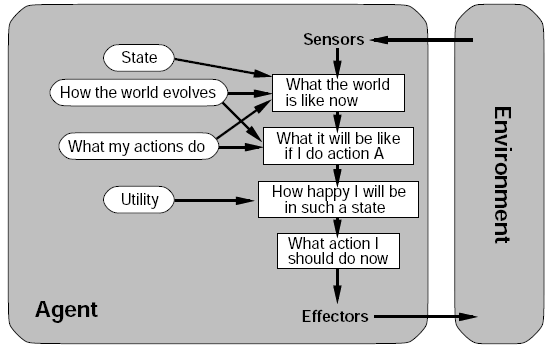
In "Artificial Intelligence - A Modern Approach", by Stuart Russell and Peter Norvig, a book I read for a university class on AI, several types of agents were introduced, in increasing order of complexity.
  • Simple reflex agents: these agents have a set of condition-action rules that determine their next action
  • Agents that keep track of the world: agents with an internal state, with memory if you will
  • Goal based agents: agents that use search and planning to reach their goals
  • Utility-based agents: agents that select the best action to reach a goal, if multiple actions are available

The utility-based agent (from "Artificial Intelligence - A Modern Approach")

Maslow on Human Needs

In "Motivation and Personality" Abraham Maslow unfolds his positive theory of the human psyche, in which the concept of needs has a central role. Maslow describes a hierarchy of basic human needs.
  • Physiological needs: the need for food, oxygen, sleep, sex, ...
  • Safety needs: the need to be in a safe place, both physically and phychologically
  • The belongingness and love needs: the need to be loved, to give and receive affection
  • The esteem needs: the need to be valued by others
  • The self-actualization need: the need to express their individual nature

The basic needs (from Wikipedia)

As Maslow is a cognitive psychologist, he describes the human needs in a functional way. Almost ready to be modelled in a computer model.

A needs-based agent is then simply an agent that acts according to his needs.

The Difference Between Goals and Needs

You are entitled to ask yourself if a need is not simply another term for a goal. Indeed, a need has the aspect of something that is to be reached, just like a goal. Also, search and planning are needed to fulfill a need. But there's an important difference: needs are not goals in themselves; needs cause goals.

Take the need for food for example: when you're hungry, eating becomes a goal. But when you're not hungry, there's no goal. In fact, when you've eaten too much, avoiding more food may become a goal in itself. ;)

To frame hunger in functional terms:
  • Need: the need for sugar
  • Resource: the amount of sugar present in the body
  • Desired state: at least n grams of sugar
  • Present state: too low
  • Goal: a certain level of sugar in the body
A need then, is a process that constantly monitors a certain resource. When the desired amount of the resource differs too much from the available amount of the resource, the process creates a goal to reduce this difference and restore the balance.

Note also, that many needs are dormant. This is where the hierarchy comes in. Higher needs are only activated when lower needs are fulfilled. One only thinks of writing a blog post after he has eaten, is in a safe place, and is loved by others.

A New Agent Diagram

Since I picture this agent as an elaboration of the existing agent types, it lies within reason that I create an agent diagram for it, that extends the utility based agent. Here it is:


The needs-based agent (my own production)


The Sims

As I finish this article, I notice an article that I had not seen before. It is written by Robert Zubek on the information structure of the computer game The Sims.


The Sims, that my wife and children play a lot, is based on exactly this agent architecture. Quoting from the article:

Needs correspond to individual motivations: for example, the need to eat, drink, or rest. The choice of needs depends very much on the game. The Sims, being a simulator of everyday people, borrowed heavily from Maslow’s hierarchy (a theory of human behavior based on increasingly important psychological needs), and ended up with a mix of basic biological and emotional drivers.

Finally

I think this type of modelling will become more important as applications are used to model human behavior. It is a good idea to introduce a new type of agent for it.


Saturday, April 1, 2017

Quantifier Scoping

I never really got it. Quantifier scoping. In the CLE book [1] it is introduced with sentences like
John visited every house on a street.
The sentence is ambiguous. I can mean "John visited every house on street S" and "John visited every house that is located in a street".

The Blackburn and Bos book [2] features sentences like
Every boxer loves a woman.
These sentences have in common that they are not typical sentences you would use when interacting with a database. I never paid much attention to them. My attitude was one of I'll cross that bridge when I get to it.

Quantification in Predicate Calculus

What I should have taken from it was that these are just (clumsy) examples of very fundamental logical property called quantification. To refresh your memory I'll just quote from that Wikipedia article:
The two most common quantifiers are the universal quantifier and the existential quantifier. The traditional symbol for the universal quantifier is "∀", a rotated letter "A", which stands for "for all" or "all". The corresponding symbol for the existential quantifier is "∃", a rotated letter "E", which stands for "there exists" or "exists".
Quantifiers are about quantity. Therefore the natural numbers (1, 5, 13) are just as important quantifiers.

Example sentence

In my NLI library I have set of integration tests that involve sentences in the field of human relationships. A month ago the following question came to mind:
Does every parent have 2 children?
and I knew my library could not handle this sentence. Why not? Suppose there are three parents in the database and each has 2 children. When I collect all these parents and children, I find that there are 6 of them. And 6 is not 2. So the library will say no while the answer should be yes.

The relational representation of the sentence at that time was

have(P) 
subject(P, S) parent(S) determiner(S, D1) isa(D, all)
object (P, O) child(O) determiner(O, D2) isa(D2, 2)

It must be rewritten to get rid of the "vague" (this is the official term) verb "have", because "have" does not have, and cannot have, a representation in the database.

have_child(S, O) 
parent(S) determiner(S, D1) isa(D, all)
child(O) determiner(O, D2) isa(D2, 2)

NLI Literature

I read about the subject in all the books and articles I currently have at my disposal and I learned that the LUNAR system (Woods) was the first milestone in handling quantification. CLE was the system that handled quantification most extensively.

Quantification is expressed in a sentence through determiners, quantifiers, more specifically, and there's such a thing as a quantifier phrase QP. Examples of quantifier phrases are

every
all
some
much
21
more than 2
between 2 and 5
one or two
at least three-fourths of

Quantifications are nested. The problem with this nesting is that it changes a relational representation from a simple unordered set to a tree structure of unordered sets. That's another reason I postponed it as long as I could. The other problem is that the order of nesting is not syntactically determined. In some cases quantifier A has wider scope than quantifier B and in other cases it is the other way around. It depends on the type of quantifiers. There are hard rules that govern this ordering, and preferences.

I finally stranded at the Core Language Engine as the most useful resource. But I found the chapter on quantifier scoping hard to digest. Thankfully, it was based on a separate article by Douglas B. Moran, a member of the CLE team, which was much better readable. I get happy whenever I think about it:

Quantifier Scoping in the SRI Core Language Engine - Douglas B. Moran

The Scoping Algorithm

I will now describe how an unscoped representation is transformed into a scoped representation. It is loosely based on the algorithm of CLE, but some details were not given in the papers and I had to fill in myself.

But before I do that, you must know about the concepts of this domain.
  1. The Range is the set of entities that form the domain of the quantifier. In the example "every parent", the range is formed by all parents.
  2. The Quantifier is the set of relations that were originally in the quantifier phrase. It is the "every" and the "2" in the example sentence.
  3. The Scope of a quantifier is the set of relations where the quantifier applies.
  4. A Quantification is a relation that binds the lot together.
Let's start with the earlier named example

have_child(S, O) 
parent(S) determiner(S, D1) isa(D1, all)
child(O) determiner(O, D2) isa(D2, 2)

I changed the determiner predicate into quantification (quantification(range-variable, range, quantifier variable, quantifier)), because it better reflects the meaning

have_child(S, O) 
parent(S) quantification(S, [], D1, []) isa(D1, all)
child(O) quantification(O, [], D2, []) isa(D2, 2)

In a separate step I place the range and the quantifier into the quantification. In this exceptional step that only applies to quantifications, the relations below the dp() phrase are placed in the fourth argument, and the relations below the nbar() phrase are placed in the second argument.
rule: np(E1) -> dp(D1) nbar(E1), sense: quantification(E1, [], D1, []);
the result

have_child(S, O) 
quantification(S, [ parent(S) ], D1, [ isa(D1, all) ]) 
quantification(O, [ child(O) ], D2, [ isa(D2, 2) ]) 

This is called the unscoped representation. In CLE it is called the quasi logical form and  quantification is named qterm in CLE.

The next step is essential: it orders the quantifications based on hard rules and preferences. I currently have a very elementary implementation that sorts the quantifications using a sort function that takes two elements and determines their order
  1. if both quantifiers are "all" leave the order as is
  2. if the first quantifier is "all", it must go first
  3. if the second quantifier is "all", swap it to go first

LUNAR and CLE have much more rules at this point. I have not needed them yet.

Next, the quantifications are nested in sorting order. At this point the quantifications are turned into quants, the term used in CLE. The arguments are like that of quantification, except that one is added: scope. The lower ordered quant is placed inside the scope of the higher ordered quant:

quant(S, [ parent(S) ], D1, [ isa(D1, all) ], [
     quant(O, [ child(O) ], D2, [ isa(D2, 2) ], [])
])

Finally, I place the unscoped relations inside the scope of the quants. I do this by going through these relations one by one. Its default scope is outside of the quants. Then I step through all nested scopes, from outside to inside. Whenever the range variable of the quant matches one of variables of the arguments of the unscoped relation, the scope changes to that new inner scope. The unscoped relation is added to the last chosen scope.

quant(S, [ parent(S) ], D1, [ isa(D1, all) ], [
     quant(O, [ child(O) ], D2, [ isa(D2, 2) ], [
        have_child(S, O)
    ])
])

Execution

After the quant relations are produced, they are executed differently from normal relations while processing a sentence.

To evaluate a quant, these steps are taken
  1. Bind the range. The relations from the range (i.e. parent(S)) are bound to values in the database. This results in a set of bindings for the variable (S).
  2. Bind the scope. The relations from the scope (i.e. the inner quant, and have_child()) are bound to values in the database. This results in a second set of bindings featuring among others the range variable (S).
  3. Validation. The range bindings and the scope bindings are now evaluated through the use of the quantifier. The quant with quantifier "all" is only true if the number of range bindings equals that of the scope bindings. The quant with quantifier "2" is only true is the number of scope bindings equals 2.

Conclusion

Quantifier scoping handles the fact that the semantics of determiners cannot be created with rewrite rules alone. It makes the process of interpreting a sentence a lot more complex. But it is a necessary step in that it resolves some ambiguities. And above all, it is necessary for many aggregation functions that apply to quantities of temporary results. Scoping these quantifications is part of understanding the sentence.


[1] The Core Language Engine
[2] Representation and Inference for Natural Language

Unbound variable unification in Prolog

In a logical language like Prolog, the statement X = Y doesn't mean that the value of Y is assigned to X, it means that both variables ...